By John Griffith, Lead Counsel.
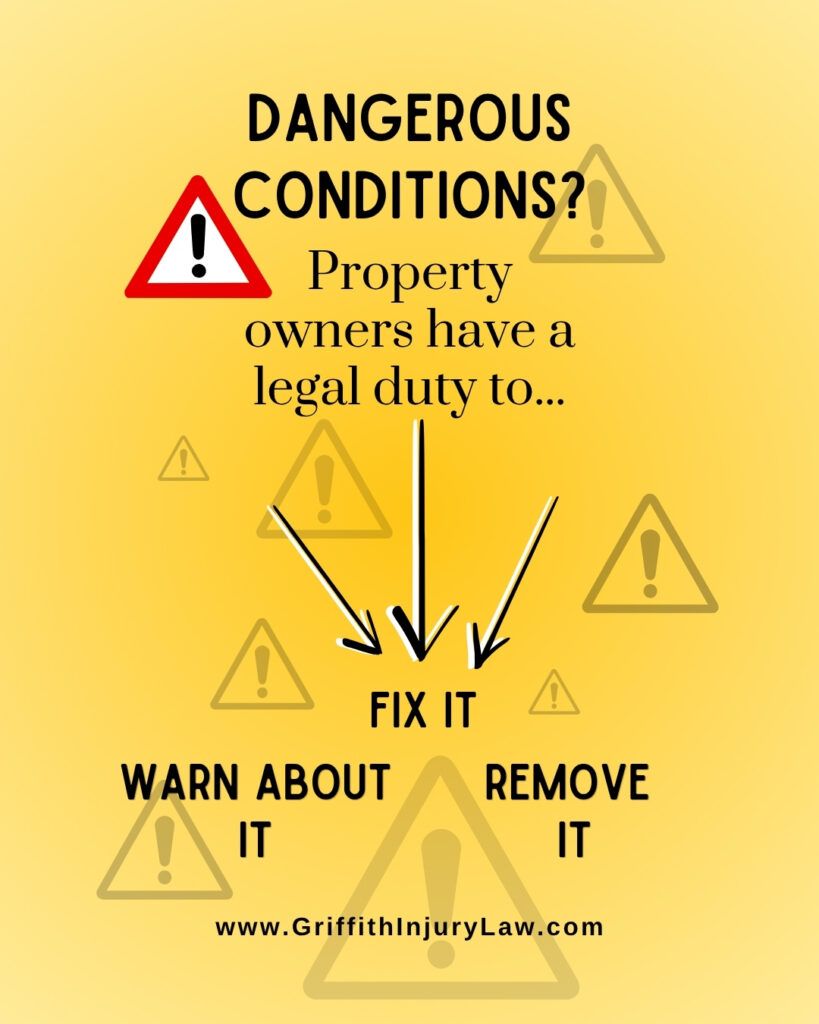
As a premises liability lawyer, I’ve spent years in courtrooms across Franklin, Nashville, Murfreesboro, and Clarksville fighting for people who were hurt because a property owner didn’t keep their space safe. Premises liability law is simple, in theory: if you own or control a property, you have a legal duty to fix, warn about, or remove dangerous conditions before someone gets hurt. In practice, it’s one of the most contested areas of personal injury law, because insurance companies almost always try to shift blame onto the injured person instead of the property that failed to protect them.
They really love to do this in slip and fall cases, which make up a big portion of the premises liability claims our firm handles. Now, the insurance defense playbook rarely disputes that a hazard existed… instead, they argue your client should have seen it, avoided it, or somehow protected themselves from a danger the property owner allowed to exist in the first place. That’s called comparative fault, and if you don’t fight it head-on, it can wipe out a case that should have been a clear win.
What Counts as a Premises Liability Case in Tennessee?
People ask me this all the time, and the honest answer is: more situations than most folks realize.
Premises liability isn’t just slip and fall cases in grocery stores. Over the years I’ve handled premises liability claims involving:
- wet stairwells with no handrail
- broken parking lot pavement that nobody bothered to repair
- poorly lit stairwells in apartment complexes
- dog bites on someone else’s property
- falling merchandise in retail stores
- swimming pool accidents where a property owner ignored basic safety requirements
If a property owner or manager knew — or reasonably should have known — about a dangerous condition and didn’t fix it or warn people about it, that’s premises liability.
Tennessee law puts the responsibility on property owners and businesses to keep their premises reasonably safe for the people they invite in, whether that’s a customer, a tenant, or a guest. That doesn’t mean every fall or every injury on someone else’s property automatically means they’re liable; it means the property owner had a duty, and my job is proving they failed that duty and that failure caused the injury.
Schedule your case evaluation with John Griffith. It’s FREE!
We Protect Your Family.
No fee unless we win.
Call (615) 807 7900 — available 24/7.


What Does a Lawyer Do in a Premises Liability Case?
A premises liability lawyer investigates the property owner’s negligence, such as unsafe conditions, lack of warnings, and poor maintenance. They also gather evidence like video footage, inspection records, and expert testimony to establish the owner knew or should have known about the hazard. And of course, they fight back against comparative fault defenses that try to blame the injured person. They also calculate the full value of medical bills, lost wages, and pain and suffering, and negotiate with or litigate against the property owner’s insurance company to secure fair compensation — taking the case to trial if a fair settlement isn’t offered.
What I’ve learned handling these cases is that it all boils down to the facts:
How long was the hazard there? Did the store have a policy for inspecting the floor? Was there video? Did an employee walk right past it?
These are the details that separate a case we can win from one the insurance company will try to bury. Even in a case where the property owner was clearly negligent, the insurance company’s whole strategy is to convince a jury my client should share the blame. If we let them, they will likely pursue some degree of comparative fault. However, premises liability attorneys have strategies that we can implement to reduce the chances of allowing this to happen.
Recently, I had a slip and fall case against a national grocery chain. The defense had alleged comparative fault for not seeing a “very bright” green bean on the floor. None of the store employees saw this bright green bean for over one hour according to the video — not even the employees who walking right over it. Yet this store’s insurance lawyers claimed my client should have seen it before he slipped on it and had to have his knee replaced after it smashed into the concrete floor.
But here’s the key: if the defense raises an affirmative defense, then it is their burden to show that my client did something wrong.
Visibility vs. Conspicuity: The Premises Liability Argument Insurance Companies Don’t Want You to Know
In my slip cases, I like to consult with a “human factors expert.” My experts tell me that it is not a matter of visibility, but conspicuity. That simply means there are always things that are competing for our attention. It could be a piece of trash blowing in the breeze, an attractive person ahead of us, a bird flying by, the scent of a distracting perfume hanging in the air, or any number of things. Even though something hazardous may be visible, you can only protect yourself if it happens to catch your attention at that particular moment in time.
This is why it’s important to use “exciter colors” to draw attention to a dangerous condition in an otherwise “safe” place.
It’s human nature to look around at things, and circumstances matter. If you’re hiking in a treacherous part of the woods, or if you’re in a junkyard, you’re probably paying direct attention to the ground in front of you. But walking down a sidewalk or in a grocery store, you feel safe; there’s no reason to have an unusual focus on your feet. It’s dangerous to walk with your head constantly down at your feet, ignoring your other surroundings. And more importantly, walking around looking at your surroundings in a “safe” place is not negligent.
That Treats You Like Family.
Call (615) 807 7900 or fill out our form to get started today.
My Closing Statement as a Premises Liability Lawyer
“It is the defendant’s burden of proof by the greater weight of the evidence that the plaintiff should be held at fault. Not ‘us.’ We have a lot of things to prove, but that is not one of them. They have that burden; they must show Mr. Johnson did something wrong, that he acted unreasonably, that he acted more likely right than wrong.
It is not enough that someone else might have seen it or done something different.
It is not enough that he could have seen it.
It is only enough for the defense to meet their burden of proof for them to prove to you that my client did something wrong.
Walking and being open to distractions in nature around you is not being unreasonable. Had my client been walking backwards, covering her eyes, reading a text or sending e-mails while looking down at her phone, that would be different, but there is absolutely no evidence of that.
The plaintiff was minding his own business, doing nothing wrong. They suggest he was talking on his phone. Even if he was, it would make no difference, because walking and talking is not unreasonable. If it did, then that means anyone at lunch, walk alongside someone else, should shut their mouth because that would be unreasonable. Don’t talk on your cell phone. From now on in America, we must walk in silence.
That’s ridiculous.
He was in a place where he had every reason to feel safe. He was watching his surroundings like everybody else; he just happened to step in the wrong space at the wrong time. The defense has presented you no evidence that our client did anything wrong. He encountered something that absolutely did not belong there and was extraordinarily dangerous. Because of that he fell and smashed his knee on the concrete floor and wound up losing his ability to walk pain free for the rest of his life.
So I ask you folks to please bring back the only verdict under the law and evidence that is justified which is zero comparative fault. In jury selection, we talked about how some people felt there should automatically be some fault. None of those people are sitting on this case. Every single one of you said “absolutely not,” that you would not do that, and we took your word for it, and we are at peace that no one is going to do that. There were a lot of people called, but only a few were chosen, and based upon your representations, and based on the law and the facts, there is only one true verdict: ZERO comparative fault.”

Let Us Fight for You.
Serving Franklin, Clarksville, Murfreesboro & beyond. Call (615) 807 7900.
Work With an Experienced Premises Liability Attorney
Every month, we submit premises liability cases just like this one to a focus group. We test our own cases and we can do it for you as well.
The feedback we get from potential jurors completely changes the game!
We can conduct up to three focus groups per event. If you have any type of injury case that you’d like feedback on, please give me a call and let’s get to work. If your case is worth trying, it is worth conducting a focus group on.
You can never settle your case for what a jury may give your client at trial.

Family's Future?
Free, confidential case review. No fee unless we win. Call (615) 807 7900.